
Control and management of IPM: a puzzle to understand
The work of pest control, in the broad sense, can be exciting, exciting and very rewarding. It is said to be a noble profession that with just a little effort provides enough profits to attract many to this activity.
Technical summary
- Focus
- The work of pest control, in the broad sense, can be exciting, exciting and very rewarding.
- Approach
- It brings together technical criteria linked to Edición 15, control de plagas and gestión.
- Use
- Useful for professionals who need context, diagnosis and operational decisions in urban pests.
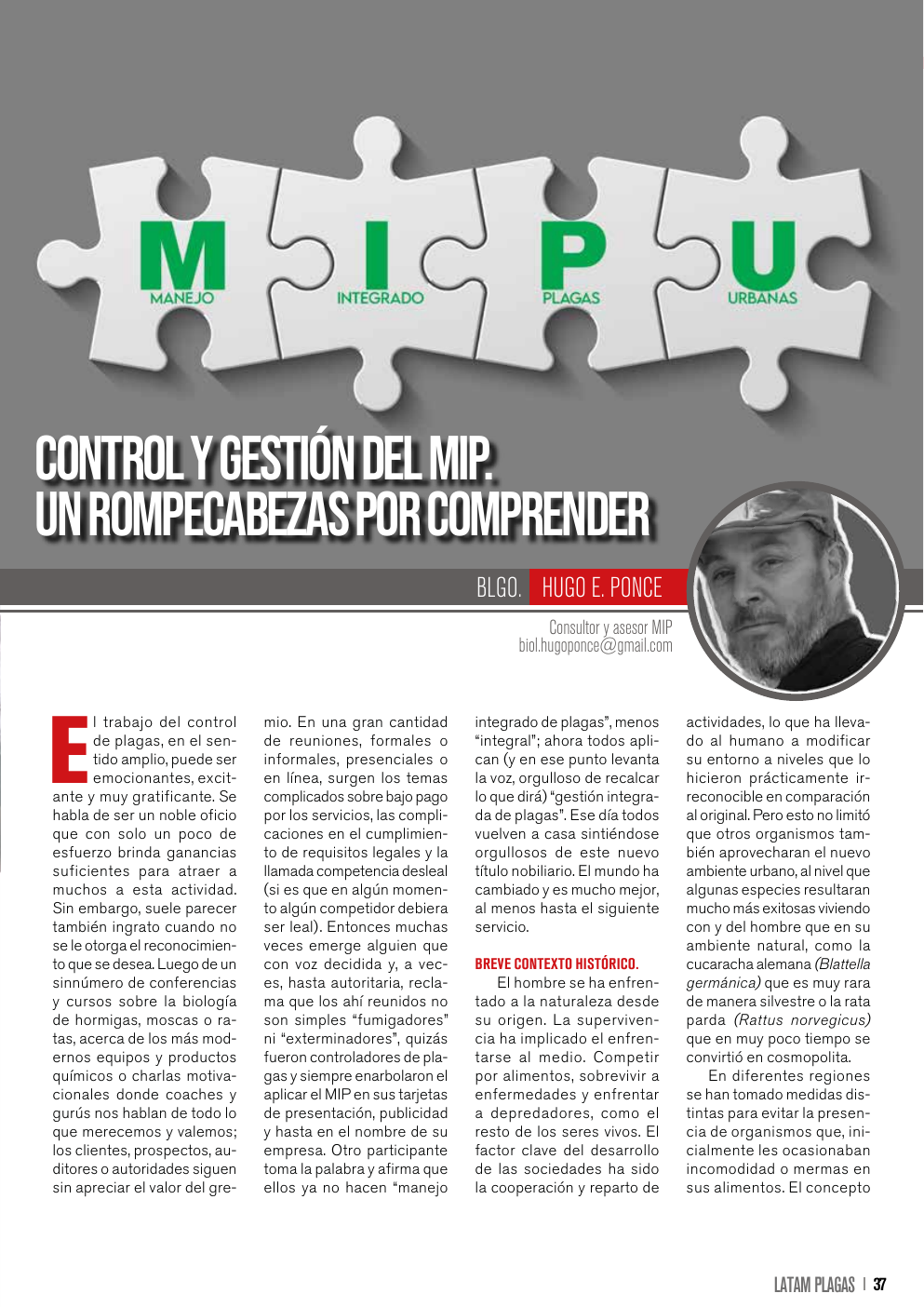
The work of pest control, in the broad sense, can be exciting, exciting and very rewarding. It is said to be a noble profession that with just a little effort provides enough profits to attract many to this activity. However, it also often seems ungrateful when it is not given the recognition it desires. After countless conferences and courses on the biology of ants, flies or rats, about the most modern equipment and chemicals or motivational talks where coaches and gurus tell us about everything we deserve and are worth; clients, prospects, auditors or authorities still do not appreciate the value of the union. In a large number of meetings, formal or informal, in-person or online, complicated issues arise about low payment for services, complications in compliance with legal requirements and so-called unfair competition (if any competitor should ever be loyal). Then many times someone emerges who, with a determined and sometimes even authoritarian voice, claims that those gathered there are not simple “fumigators” or “exterminators”, perhaps they were Pest Management Professionals and always promoted the application of IPM on their business cards, advertising and even in the name of their company. Another participant takes the floor and states that they no longer do “integrated pest management”, much less “integral”; Now everyone applies (and at that point he raises his voice, proud to emphasize what he will say) “integrated pest management.” That day everyone returns home feeling proud of this new noble title. The world has changed and is much better, at least until the next service. BRIEF HISTORICAL CONTEXT. Man has confronted nature since its origin. Survival has involved facing the environment. Compete for food, survive diseases and face predators, like the rest of living beings. The key factor in the development of societies has been the cooperation and distribution of activities, which has led humans to modify their environment to levels that made it practically unrecognizable compared to the original. But this did not limit other organisms from also taking advantage of the new urban environment, to the extent that some species were much more successful living with and from man than in their natural environment, such as the German cockroach (Blattella germánica) which is very rare in the wild or the brown rat (Rattus norvegicus) which in a very short time became cosmopolitan. In different regions, different measures have been taken to avoid the presence of organisms that initially caused them discomfort or losses in their food. The concept of disease still took many years to be associated with organisms, either as carriers or transmitters. At first, they only sought to scare them away or simply accept them. With the development of societies, certain standards of way of life also began to be created that made the absence of annoying animals necessary. This story is both long and interesting, and largely reflects the evolution of man's relationship with nature; but we will tell it another time. For the purpose of this article we will start with the beginning of the 20th century. At the beginning of the last century, various substances had already been used, mainly of organic origin, but it was at this time that forms of application began to be developed. There are already people specialized in the activity who used various names such as exterminators, fumigators or rat catchers, which were not in any way offensive but on the contrary, they created an almost heroic image. Their way of working was essentially eliminating organisms identified as pests. Although methods other than chemicals had been used for a long time, the rise of new machines increased the use of substances given the ease they provided in their application. At that time, specialized groups or associations of people and companies in the union began to be formalized. It is in 1914 that resistance as a defense mechanism by insects is officially registered, which will lead to the search for strategies. The alternating use of pesticides from different chemical classes, or rotation, was first proposed by Cayne in 1951, but still without an in-depth analysis of the modes of action. In the search for solutions by reducing the use of chemicals, in 1949 Smith and Smith proposed insect control supervised by qualified entomologists with the applications of insecticides based on conclusions obtained from periodic monitoring of pest populations and natural enemies. In 1959, Stern and his collaborators introduced the concept of integrated control based on ecological balance in ecosystems. In these years, pest control was already referred to as the activity of reducing harmful organisms. During the sixties, concern for the environment increased, influenced by the appearance of Rachel Carson's work, “The Silent Spring” in 1962, at the time of the development and birth of new areas of ecology such as population dynamics, urban and industrial ecology, what would be known as Integrated Pest Management or IPM began to take shape, which was already established by V. M. Stern, Ray F. Smith, Robert van den Bosch, and K. S. Hagen in 1957. (Bosch and Flint, 1981). A perspective of this evolution can be consulted in edition 7 of LATAMPLAGAS. IPM was incorporated into Agenda 21 of the United Nations Conference on Environment and Development in 1992. We cannot forget that services are performed by people or companies. The basic theory says that the objective of organizations is to obtain profits for the shareholders or the owner. A financial approach focused on returns. In 1984, Nobel Prize winner Milton Friedman established the stakeholder model in which, in addition to shareholders, benefits must be generated for the different groups related to the business. These benefits are, among other things, ensuring that customers are satisfied with the service and its results, achieving the well-being of technicians and other employees, obtaining financial benefits, compliance with legal and regulatory requirements, demonstrating commitment to the community and environmental responsibility. For them, it is necessary to effectively manage the resources necessary to achieve the objectives, in addition to the reduction of an organism in a pest situation. In other words, carry out adequate management of the integrated pest management program. SOME DEFINITIONS. We often hold back on the definitions of words we use in our work to support what we do. A definition is the meaning or description used to objectify a concept. That is why it is first important to understand the concept as a qualitative and abstract mental representation. Concepts are usually very relative, which is why there are sometimes several definitions, which usually generates confusion. The first concept to understand is the obvious one, plague. Among the different and multiple definitions, there is talk of population growth that causes some damage or harm. Traditionally, an organism is defined as a pest because it is the organism it is. This means that a cockroach is typically interpreted as a pest because it is a cockroach, a fly is a pest because it is a fly, and a rat is a pest because it is a rat. This has led to the assumption that pest control should focus on the reduction and attack of organisms that are related to the negative effect. In the agricultural field, it is easy to evaluate the economic and damage threshold based on the population, a measure that becomes complicated when dealing with urban problems, in which an individual in a package can cause serious reputational effects. Let's start from the beginning. Plague derives from the Latin plague, which means deep wound, sore, blow or misfortune. On the other hand, the English word “pest” also comes from the Latin pestis, which refers to a contagious, serious disease or a bad smell (which was an indication of a disease). Therefore, the common key word in the various definitions of plague is not “population” but damage. It could be somewhat less, except that this change in perspective makes it easier to approach a pest problem focused on damage and not on the number of individuals. In other words, plague is the risk that an organism causes harm to man, his health or his property. A second concept is control, which comes from the Old French controle which refers to the records or careful observation used for verification. It focuses on the process created to verify or supervise that the protocols or plans meet the stated requirements and objectives. Taking the concept of plague discussed above from the point of view of risk, it implies setting margins to measure the progress of the plan. It is precisely control that allows defining the economic and damage thresholds, which means not only measuring population levels but also the margins of damage that have been identified as a result of the presence of the organisms. At this point it is useful to remember another definition, that of risk, which according to ISO 31000 is the effect of uncertainty that can divert results from the objective. Controls establish the limits in the face of this uncertainty that must not be exceeded to achieve the goal. Let us now move on to handling, from the Italian maneggiare, manus, hand, and agere, to carry out; refers to the action of guiding. What is done to drive something towards an objective and involves having the appropriate skills, abilities and abilities to do so. As can be assumed, it is about the knowledge and use of the different tools known to reduce the risk of pests. Useful physical, chemical, cultural and biological measures, applied in a comprehensive manner, understood as compatible and synergistic, first to reduce the ability to reduce the homeostasis of organisms, the maintenance of balance with their environment, and subsequently prevent their entry, survival or dispersion, especially to sites where damage is detected or could occur. Finally, the term management, from the Greek gestionis, action of carrying out, and gerere, executing, undertaking. Assume and manage responsibilities for a process, which includes the provision of resources and the coordination of activities so that the IPM can be carried out according to plans. Management includes the identification of processes and their description and improvement, coordination and control of operation, documentation, as well as the information system for monitoring results. With adequate management, adequate and sufficient material and human resources are guaranteed to fulfill the plan, satisfying or exceeding the expectations of the interested parties, both the service provider and the contractor. When someone refers to management in English, the word management is used, which is also translated as management, which is often where the confusion comes from when the concept is used in Spanish. For this reason, sometimes it is preferred to use the term operation or driving to refer to management and differentiate it from management. SETTING UP THE IPM PLAN Let's go back to that bright moment of the meeting in which everyone leaves proud of being “pest managers”. The need for recognition is independent of the ability to perform a task. You can be a great expert, the most productive or efficient at what you do, but not feel satisfied by not feeling the approval of those you expect to receive. This frequently leads to seeking that recognition from oneself, through statements or adjectives that highlight it, a tool that coaches and motivators frequently use, but which is outside of reality. Cognitive dissonance occurs when ideas or concepts that conflict with those that allow us to stay in our comfort zone or status are avoided, ignoring or discrediting them. The theory of self-perception refers to the deduction we take from our attitudes, especially when we are not sure about them, especially if a third party makes us think so (or we assume that they have it). On the other hand, we generate a self-concept, which is a set of characteristics that we seek to define us, consciously or unconsciously. In short, we generate an image for ourselves and another as we want to be seen; which would not be a problem unless it influences a false conception of aspects related to the development of our work. As we have seen, talking about control, management or management is not about hierarchical growth, a career plan or an achievement, award or title for seniority, experience (figure 1). The use of an adjective is also often used to reinforce the image that is sought to be established among interested parties, especially clients. A very illustrative case is the evolution of the organization that brings together companies and professionals dedicated to pest control in the United States, the NPMA. In 1933, the first association was founded, the National Association of Exterminators and Fumigators, which only 4 years later, in 1937, changed its name to the National Pest Control Association (NPCA), so that in 1999 it was decided to change it to the National Pest Management Association, with the argument that “management” is friendlier and has positive connotations (as well as more easily understandable) for clients and society (PMP, 2013). Management and control are actually pieces of the same puzzle that have been added as the way of addressing pest risk has evolved, hand in hand with paradigm shifts, especially in the recent century. To obtain the best results, it is very important to treat pest problems from a comprehensive point of view within a framework of continuous improvement of the IPM in different positions related to the problem or risk or selection of the ideal chemical products and their forms of application, according to each case. Controls are established that allow regular follow-up and monitoring of the plan, which is useful to take as a reference the famous Deming Circle or PDCA (PHVA) (figure 2). By defining strategies in a structured and compatible manner for pest risk management, such as cleaning, changing furniture, structural corrections or adjustments, changes in employee culture or, for example, population levels, but also damage records, complaint rates, customer satisfaction levels or increased productivity in production, among others; in order to adjust, correct or maintain said strategies, which is normally what an adequate trend analysis would indicate developed from the incidences of pest organisms and evidence of damage. The success of the development of the plan depends on guaranteeing the number and competence of people involved in the application of each strategy. Of course, the service cannot be provided if it does not have the corresponding license or permit, if it is not compatible with the client's regulatory or legal compliance or if there is some type of opposition from the neighbors. Without proper management, the plan would be deficient at best (figure 3). technicians, sales manager, customer service, supervisors or whoever will provide awareness to the contractor's employees; It is also important to guarantee having the necessary inventory of the pesticides considered, the condition and proper functioning of the equipment, and a sufficient supply of gasoline in the vehicles. Treating pest risk depends on good handling, control and management, not just promotion and good intentions. BIBLIOGRAPHICAL REFERENCES Flint, M. L. and R. van den Bosch. 1981. Introduction to Integrated Pest Management. Springer US, 1. Cloyd, R. A. (2010) Pesticide mixtures and rotations: are these viable resistance mitigating strategies? Pest Technology 4 (1), 14-18 Coyne FP (19519 Proper use of insecticides, British Medical Journal 4736, 911-912 PMP (2013) 80 Game Changers in PMP History. 80th Anniversary Issue Smith, R. F. and G. L. Smith (1949) Manual of supervised control, Division of Entomology and Parasitology, University of California, Berkeley. 27 p.