
Physical-mechanical control of urban pests
We live in a moment that more than ever demands changes in behavior and paradigm shifts, where human beings seek a safer and more ecologically healthy future.
Technical summary
- Focus
- We live in a moment that more than ever demands changes in behavior and paradigm shifts, where human beings seek a safer and more ecologically healthy future.
- Approach
- It brings together technical criteria linked to Edición 13, control físico and control mecánico.
- Use
- Useful for professionals who need context, diagnosis and operational decisions in urban pests.
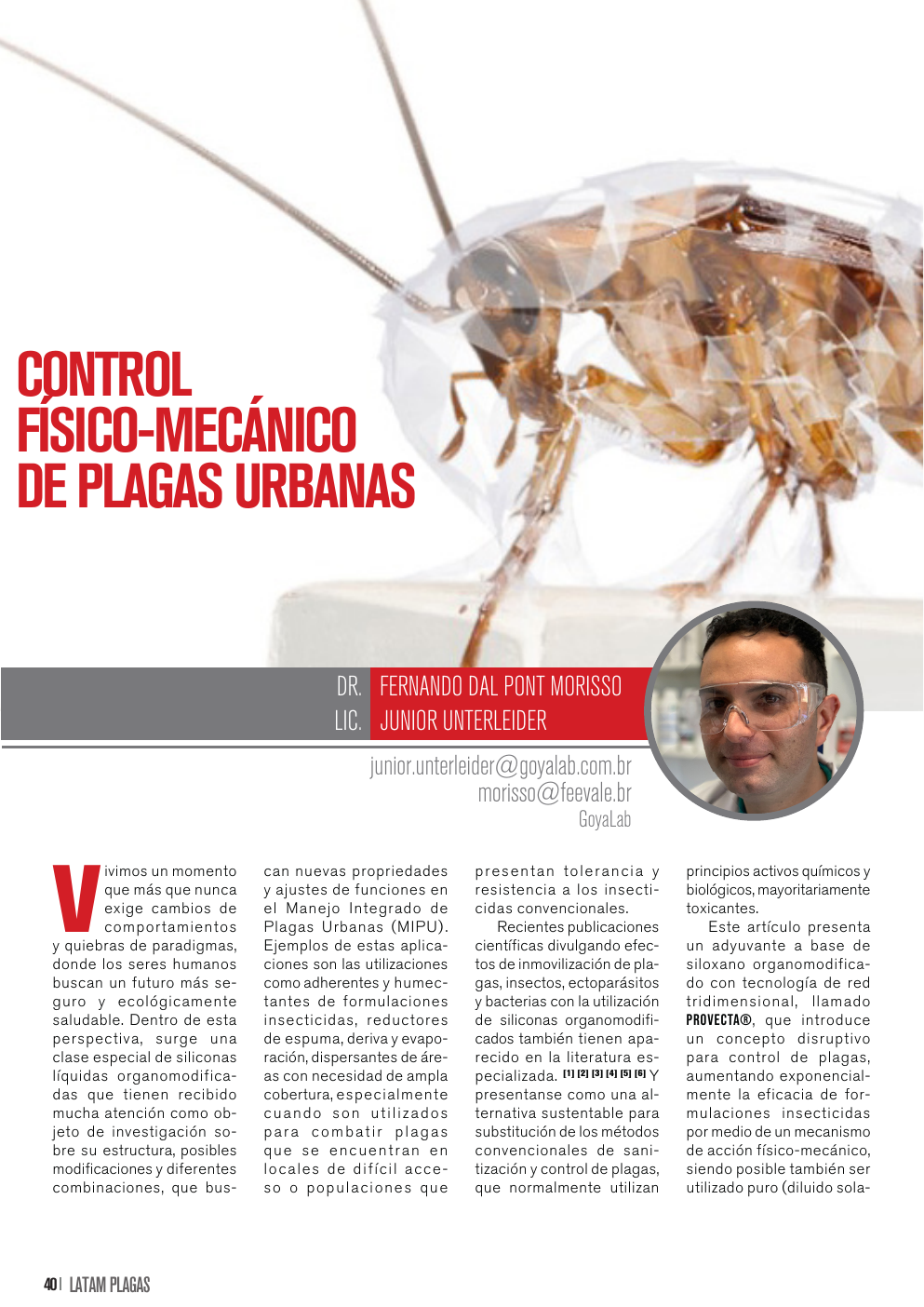
We live in a moment that more than ever demands changes in behavior and paradigm shifts, where human beings seek a safer and more ecologically healthy future. Within this perspective, a special class of organomodified liquid silicones emerges that have received a lot of attention as an object of research on their structure, possible modifications and different combinations, seeking new properties and function adjustments in Integrated Urban Pest Management (IPM). Examples of these applications are uses as adherents and humectants of insecticidal formulations, foam, drift and evaporation reducers, dispersants of areas with a need for extensive coverage, especially when they are used to combat pests that are found in places that are difficult to access or populations that have tolerance and resistance to conventional insecticides. Recent scientific publications disclosing immobilization effects on pests, insects, ectoparasites and bacteria with the use of organomodified silicones have also appeared in specialized literature. [1] [2] [3] [4] [5] [6] And they are presented as a sustainable alternative to replace conventional methods of sanitation and pest control, which normally use chemical and biological active ingredients, mostly toxic. This article presents an adjuvant based on organomodified siloxane with three-dimensional network technology, called Provecta®, which introduces a disruptive concept for pest control, exponentially increasing the effectiveness of insecticidal formulations through a physical-mechanical mechanism of action, being also possible to be used pure (diluted only with water) to suppress insects and arachnids through immobilization, without the need for insecticides, pesticides, or other toxicants, allowing a completely new and promising approach to the current problems of the pest control industry, due to the innovative ability to eliminate urban pests through physical-mechanical action. Provecta® is an emulsifiable concentrate (EC) that completely conceals and immobilizes pests with the creation of a three-dimensional immobilizing polymer mesh structure, being a new technology identified as ALL-IN-WEB™ (Three-dimensional Immobilizing Polymeric Network Structure), developed and patented by the ICB Pharma laboratory in Poland. [3] Polymeric meshes have a physical-mechanical mode of action through being highly effective against different species of insects, flies and arachnids. [4] [5] [6] Field evaluations confirmed a significant increase in the effectiveness of conventional formulations against ticks, selected from strains highly resistant to the same active ingredients to which they were subjected to the analysis and that, when the Provecta® adjuvant was added, they obtained maximum effectiveness and total annihilation of the ectoparasites. [2] The bacteriostatic effect was also analyzed and antimicrobial properties were verified, concluding that this function is physical-mechanical through the creation of a layer of coating that reduces the cellular adhesion of bacteria. It was recorded that the spatial mesh structure is based on substances non-toxic to traditional chemicals by this type of organomodified silicone. Due to the mechanism of action of these silicones being purely physical-mechanical blockage, the chances of organisms creating resistance are significantly reduced. [6] When in contact with water, Provecta® creates a totally permeable molecular structure, which causes immediate encapsulation and paralysis of pests, through the spraying of a three-dimensional polymeric network, which conceals insects and arachnids, blocking their movements, leading the pests to exhaustion and subsequent suppression, without the need for insecticides or other toxicants. When Provecta® adjuvant is mixed with water, the organo-mineral compounds of its formulation are catalyzed in a sol-gel method through the formation of inorganic networks in the presence of organic polymers. [9] The formation of the polymeric mesh occurs through the pectization process (solgel), where the silica particles are synthesized from the hydrolysis of the precursor (water) in an aqueous catalyst base, which leads to the initiation of the polycondensation process, resulting in an elongation of the siloxane chain[7]. This polycondensation reaction occurs according to the Stöber mechanism and forms a spatial structure of immobilization of the polycondensate from branched polyssiloxane chains [6], resulting in the union of molecules of elongated structures that, when applied to the surfaces, create a three-dimensional polymeric mesh structure. [7] The colloidal solution (sol) acts as a precursor for a network inPROVECTA® IS A RECOMMENDED HYBRID FORMULATION FOR URBAN PEST CONTROL. IT IS INDICATED TO BE MIXED INTO INSECTICIDAL FORMULAS AS AN ENHANCER OR IT CAN BE USED PURE WITH WATER. TO BE APPLIED IN PREMISES WHERE THE USE OF CONVENTIONAL INSECTICIDES IS LIMITED OR RESTRICTED. of the creation of a three-dimensional structure that adheres to insects and quickly immobilizes their movements, leading to the elimination of pests. [6] The control effectiveness and suppression level of these immobilizing polymeric networks were evaluated and concluded to be human and environmentally friendly. In the same way, this type of silicone-based product, to combat insects by immobilization, is in accordance with organic principles and Integrated Pest Management (IPM), [4] therefore being viable to replace tegrada (gel) of polymeric particles interconnected in a network. This polycondensation technique favors the dispersion, at the molecular level, of the inorganic precursor (siloxane) within an organic matrix (water) to produce covalent ligations forming colloidal particles maintained by electrostatic force and Van der Waals force in the liquid phase (sol). Next, a rigid structure interconnected with polymer chains and micropores (gel) is formed. [8] Therefore, as soon as it touches the surface (exoskeleton and external areas of the insects' body) the sprayed drops of Provecta® will connect, according to the evaporation of the base water of the solution, forming a polymeric network that grabs the pests and blocks all their movements. Provecta® acts mechanically by immobilization, through the creation of a polymeric mesh that conceals the insects and paralyzes all their movements, leading the pests to exhaustion due to lack of energy and consequent suppression. Provecta® does not have any direct chemical interaction with the biochemical and physiological processes of the target pests. When applied topically on insects and arachnids, it creates a polymeric mesh that completely envelops the pests, keeping them immobilized until total exhaustion of their energy sources occurs, consequently leading to mortality. Safety evaluations, toxicology studies and laboratory tests prove the total safety of Provecta® for people, animals, the environment and plants. [11] Fig X. Spiders immobilized by Provecta® diluted only with water (A), scanning electron microscopy showing the exoskeleton and spiracles of the spider without any type of treatment (B) and with application of Provecta® showing how the immobilizing polymer mesh is formed (C). Fig. X: Accelerator effect for insecticidal formulations. When mixed with insecticidal formulations, Provecta® has the function of improving effectiveness, increasing the penetration of the solution and modifying the exposure of insects, through increasing the bioavailability of the active ingredients contained in the insecticidal formulas. Provecta® boosts the dispersion of the insecticide, resulting in greater concealment of the treated area and greater penetration of the working solution into floors, walls, edges, ceilings, fissures, crevices, crevices, drains, or other hard-to-access locations and any place where insects and arachnids can hide. Pest movements are immediately blocked, preventing insects from fleeing and reducing the chances of ataxia and hyperactivity, caused by the volatile chemical compounds contained in traditional insecticide formulas. This strong dispersion of Provecta® causes a complete concealment of the exoskeleton of the pest-object and consequently a greater delivery of insecticidal solution, according to Fig. EXAMPLE OF EFFECTIVENESS AGAINST MOSQUITOES: Recent evaluations carried out by Prof. PhD James Logan and his team at the London School of Hygiene and Tropical Medicine, confirmed the effectiveness of 100% mortality of the N'guesso mosquito (Anopheles coluzzii), the main vector of transmission of Malaria, when having contact with just one microdroplet (0.2μl) of a 99.5% water and 0.5% solution. Provect®. Graph 1. Insecticidal activity of Provecta® against N'guesso mosquito (Anopheles coluzzii). For the first two repetitions (4 batches), the insecticidal activity of different concentrations of Provecta® were tested in an application volume of 0.2μl. In this volume, concentrations of 0.50% and 0.75% Provecta® caused 100% mortality within 24 hours. Knockdown after 1 hour and mortality in 24, 48, 72, 96 and 120 hours after the application of 0.2μl of Provecta® in five concentrations in female N'guesso mosquitoes (Anopheles coluzzii). MAIN ADVANTAGES OF PHYSICAL-MECHANICAL CONTROL OF URBAN PESTS:
- Fights various species of insects and arachnids.
- Non-toxic, contains no active ingredients.
- Does not leave residue. No smell. Colorless.
- Physical mode of action reduces the possibility of pests becoming resistant.
- Physical-mechanical action, which acts independently of the rest of the formulation.
- Hybrid action effect increases the effectiveness of insecticides.
- Immediate immobilization effect.
- Allows the reduction of active ingredients in formulations.
- Facilitates the penetration of insecticides in places that are difficult to access.
- Working solution not classified as hazardous.
- At any time, in any location, against any pest. Bibliography: [1] Marinković. (2020). Factsheet: silicone polymer use for pest control Mosquito control products. 1–22. [2] Marques, C. B. et al. (2019). In vitro and in vivo acaricidal activity evaluation of organo-modified siloxanes in populations of Rhipicephalus microplus. Veterinary Parasitology. [3] Patrzałek, M. , et al. (2019). Preliminary evaluation of application of a 3D network structure of siloxanes preparation on chick embryo development and microbiological status of eggshells. [4] Patrzałek, M. , et al. (2020). Novel Mode of Trisiloxane Application Reduces Spider Mite and Aphid Infestation of Fruiting Shrub and Tree Crops. Silicon, 12(6), 1449–1454. [5] Salehi, M. J. (2019). Field evaluation of SilTAC® on Asian citrus psyllid compared to imidacloprid 35%SC and acetamiprid 20%SP. [6] Skalský, M. et al. (2020). Efficacy of agrochemicals against phyllobius oblongus. Plant Protection Science, 56(2), 116–122. [7] Han, Y. et al. (2017). Unraveling the growth mechanism of silica particles in the stöber method. Langmuir, 33(23), 5879–5890. [8] Sánchez-Téllez, D. A. et al. (2020). Siloxane-inorganic chemical crosslinking of hyaluronic acid based hybrid hydrogels: Structural characterization. Carbohydrate Polymers. [9] Budnyak, T. M. et al. (2016). Preparation and properties of organomineral adsorbent obtained by solgel technology. Journal of Thermal Analysis and Calorimetry, 125(3), 1335–1351. [10] Logan, J. G. et al. (2020). Activity of insect immobilizer spray against mosquitoes. Pages 3-12. [11] Summary of toxicity, ecotoxicity and efficacy of 3D-IPNS Technology (2016), ICB Pharma.