
Important concepts to consider in fly control
A correct fly control strategy must always consider the relationship between environmental (or abiotic) factors and the characteristics of the pest species since these are determinants of the intensity and...
Technical summary
- Focus
- A correct fly control strategy must always consider the relationship between environmental (or abiotic) factors and the characteristics of the pest species since these are determinants of the intensity and distribution of the...
- Approach
- It brings together technical criteria linked to Edición 15, control de moscas and latam plagas.
- Use
- Useful for professionals who need context, diagnosis and operational decisions in integrated management.
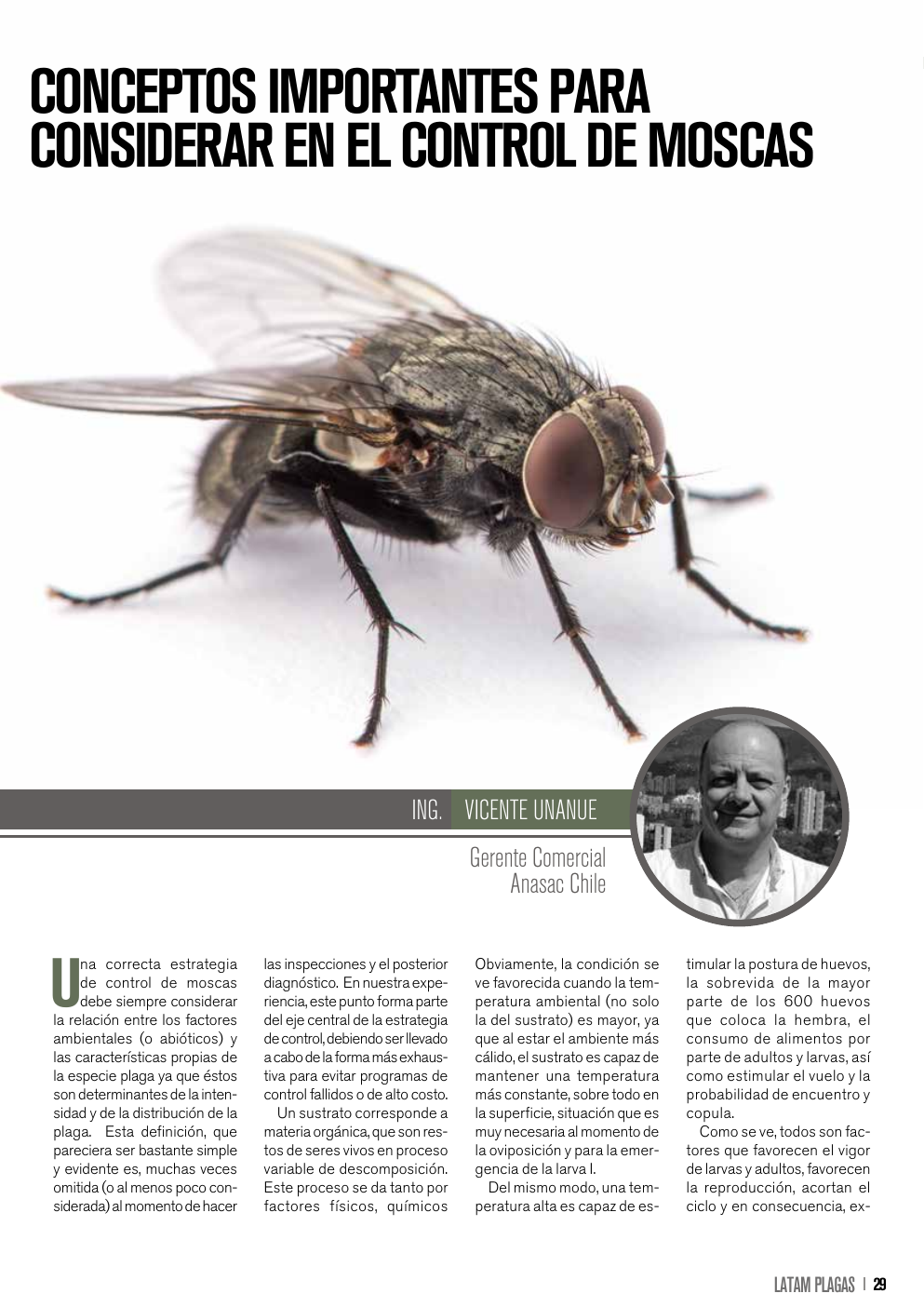
A correct fly control strategy must always consider the relationship between environmental (or abiotic) factors and the characteristics of the pest species since these are determinants of the intensity and distribution of the pest. This definition, which seems to be quite simple and obvious, is often omitted (or at least little considered) when making inspections and subsequent diagnosis. In our experience, this point is part of the central axis of the control strategy, and must be carried out in the most exhaustive way to avoid failed or high-cost control programs. A substrate corresponds to organic matter, which are remains of living beings in a variable process of decomposition. This process occurs due to both physical and chemical factors. Obviously, the condition is favored when the environmental temperature (not only that of the substrate) is higher, since as the environment is warmer, the substrate is capable of maintaining a more constant temperature, especially on the surface, a situation that is very necessary at the time of oviposition and for the emergence of larva I. Likewise, a high temperature is capable of stimulating egg laying, the survival of most of the 600 eggs laid by the female, food consumption by adults and larvae, as well as stimulating flight and the probability of encounter and copulation. As can be seen, all are factors that favor the vigor of larvae and adults, favor reproduction, shorten the cycle and, consequently, exMIP capture the best biological potential of the species. The ideal temperature for the adult flies. Humidity values less than 40% or above 95% are not viable, the cycle ranges between 23°C and 26°C, a range that determines complete cycles of between 12 and 14 days, recording egg hatches of only 14 hours or only 4 to 5 days of pupation. A second element present in the substrate is humidity. Various authors point out that substrates with a humidity that ranges between 60% and 90% are those that determine the area where the flies will lay their eggs (the oviposition area). This information must be kept in mind for management that stimulates the drying of the substrate, restricts its size and distribution (of the optimal humid areas) or in the case of chemical controls, these will be the points where the larvicide must be applied. A substrate with adequate humidity also determines the viability (or mortality of the eggs) and the survival of the first larval phase. Likewise, a substrate with this humidity range will benefit larval vitality and mobility, defining adequate feeding capacity, greater larval survival and more being discarded for oviposition. A third element to consider is the nutritional quality of the substrate. Their protein, lipid and sugar composition will determine the size and vitality of the flies. The quality of the substrate is obviously linked to the organic matter that gives rise to it, defining the nutritional contribution that the three larval stages and the feeding of the adults will receive. A good substrate and consequently will favor the expression of all the biological parameters that a successful population must have. A final abiotic element of relevance to the density of flies in an environment is odors. As is known, the concentration of odors in a given environment attracts flies, which together with a behavioral pattern of aggregation (flies gather in groups in the same place) facilitate copulation and consequently the increase in the population. When carrying out an inspection in a given environment, these four variables will be decisive for the establishment and future load of a fly population. It is these environmental variables that the pest control professional must manage, seeking to restrict as much as possible the supply of elements to achieve the lowest biological potential. Recommendations and management on environmental management are clearly one of the main problems in control. Many times temperature or humidity control, to name a few, is very difficult to do, or it is expensive, or it depends on the company contracting the services, which is not always willing to implement these procedures. However, as a pest control company it is our obligation to determine the critical elements in an environment, define a task plan and indicate the responsibilities of each of the parties in this management. The acceptance parameters will depend on the environment, and clean zones, intermediate zones and dirty zones can be defined, where there will obviously be different parameters and tolerances. Clearly, good coordination and implementation of cleaning procedures, maintenance of structures, physical controls, maintenance of ducts and drains (plumbing) will determine lower environmental offers and more controlled populations in terms of their size and distribution, which together with the correct use of chemical products will define successful control.