
How to recognize “false scorpions”
To situate ourselves in the taxonomy of false scorpions, we say that they are from the phylum Arthropoda, subphylum Chelicerata, class Arachnida and order Pseudoscorpiones, from Geer 1778.
Technical summary
- Focus
- To situate ourselves in the taxonomy of false scorpions, we say that they are from the phylum Arthropoda, subphylum Chelicerata, class Arachnida and order Pseudoscorpiones, from Geer 1778.
- Approach
- The article structures the analysis around Characteristics of “false scorpions”, Life cycle and Feeding.
- Use
- Useful for professionals who need context, diagnosis and operational decisions in edición 5.
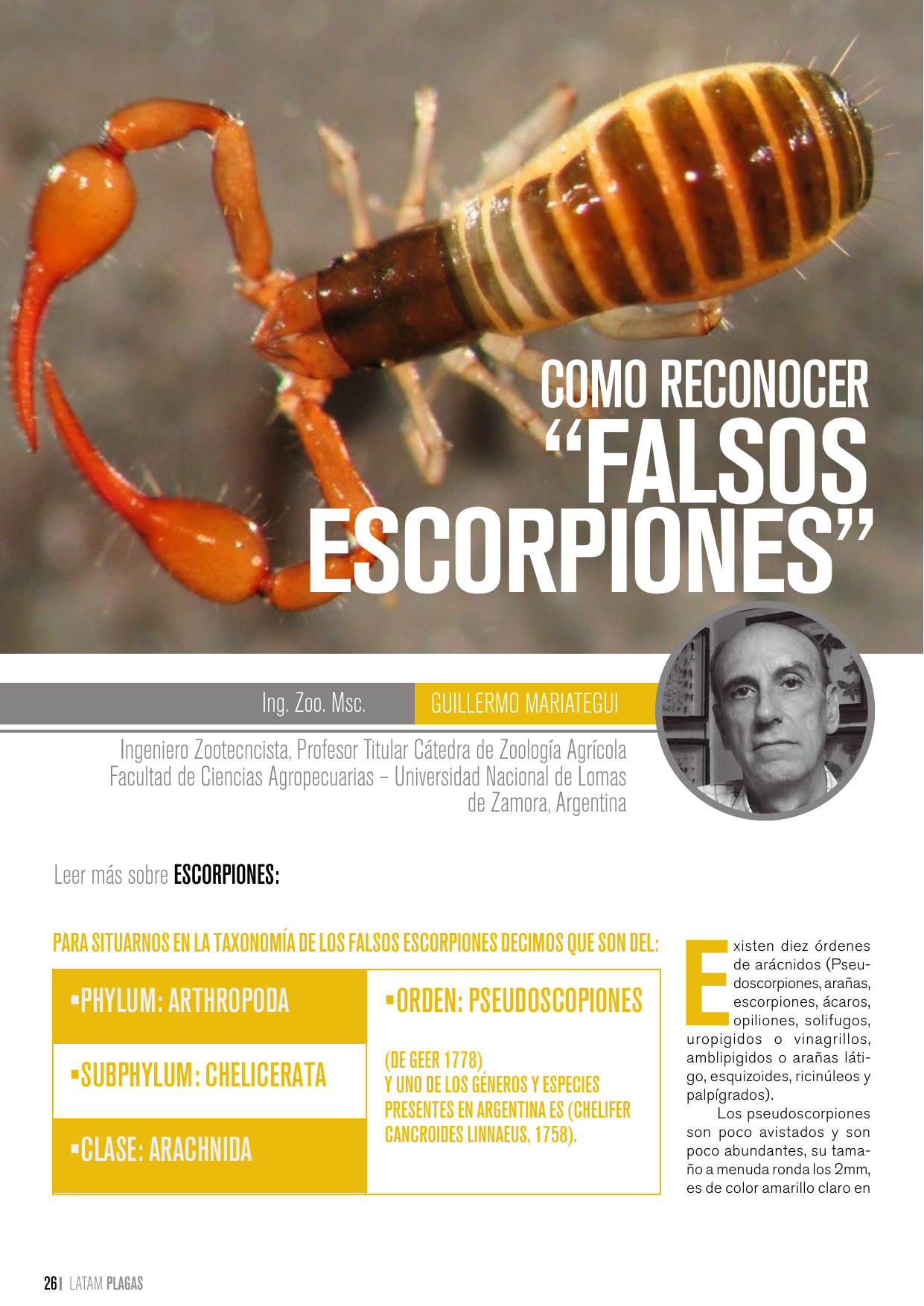
To situate ourselves in the taxonomy of false scorpions, we say that they are from the phylum Arthropoda, subphylum Chelicerata, class Arachnida and order Pseudoscorpiones, from Geer 1778. One of the genera and species present in Argentina is Chelifer canchroids, Linnaeus 1758.
There are ten orders of arachnids: pseudoscorpions, spiders, scorpions, mites, opiliones, solifuges, uropygids or vinagrillos, amblypygids or whip spiders, schizoids, ricinuleans and palpigrades.
Pseudoscorpions are rarely seen and not abundant. Its size is often around 2 mm, it is light yellow in some cases, darker and even black in others.
Characteristics of “false scorpions”
In the order of pseudoscorpions we find creatures that are often confused with scorpions at first glance; However, through closer observation, we can realize that they are very different.
They are also known as false scorpions because their front part is very similar to that of a scorpion, as it has chelicerae and pedipalps, as well as four pairs of legs, but the difference lies in the back part as it lacks a metasoma, the tail, and a stinger or telson.
They are animals that have typical characteristics of an arachnid. The chelicerae and pedipalps are appendages used to grasp food. They have four pairs of ambulatory legs that allow them to walk forward and backward and can sometimes move laterally. The body is divided into cephalothorax and abdomen.
Unlike scorpions, they produce silk threads through specific glands. They have silk-producing glands in the chelicerae and venom glands in the pedipalp pincers; They do not have medium eyes and their size is 0.8 to 12 mm. The vision of these beings is very defective and they are probably only able to differentiate light from darkness, without seeing images.
They use this silk to build silk chambers between the cracks, fixing the threads with small particles of detritus. These chambers serve as shelter for their young and also for molting and hibernating. The glands are located in the prosoma and not in the opisthosoma. Its ducts open in the mobile finger of each of the chelicerae.
Some species of false scorpions have also been found living in bookstores and libraries. In these conditions they turn out to be a good ally, since they feed mainly on the so-called book lice, psocopterans, and silverfish, common pests in these places.
They live in human dwellings, especially in closets, and outdoors under leaf litter and moss. The body is divided into tagmas; You can see the cephalothorax and abdomen. The cephalothorax is called prosoma and in the abdomen we find the opisthosoma, where the genitalia of the individual is located.
The opisthosoma and the prosoma are barely differentiated, as in scorpions. The opisthosoma also appears segmented but lacks a metasoma, which is the tail in scorpions. The anterior genital opening opens on the ventral surface of the opisthosoma. In the third and fourth segments appear the stigmata, which are part of its respiratory system and connect with the internal tracheas. The abdomen has twelve uromeres, of which only ten are visible.
Like other arachnids, its legs are made up of six segments that end in two nails and a structure called an arolio. This allows you to move across surfaces without slipping or falling.
Pseudoscorpions use their powerful pedipalps to hunt. In addition, they have fine and long hairs called trichobothria that react to any vibration and inform the animal of the external environment in which it moves. The entire surface of the body and appendages is covered with sensory hairs that allow it to perceive stimuli.
Life cycle
The life cycle of pseudoscorpions lasts 2 to 4 years, during which they go through three post-embryonic molts, with no molts starting in the adult phase. Three nymphal phases are distinguished and, until the adult, there are four stages: protonymph, deutonymph, tritonymph and adult.
They do not have marked sexual dimorphism. For reproduction, the male prepares a small territory by rubbing his belly against the ground, possibly releasing pheromones. When a female enters this territory, the male begins a rapid dance around her, vibrating his body and displaying his pedipalps. It then deposits a spermatophore on the substrate and moves backwards, guiding the female to it, so that she can pick it up.
The female produces between 20 and 40 eggs that she carries in her abdomen and which she will protect about two weeks after hatching. It has been seen that some species of pseudoscorpions are water repellent, which is possibly due to a liquid that they usually pour through their mouth and that, with the help of their pedipalps and legs, they rub and distribute it throughout the body.
Feeding
All species are predators. They hunt other arthropods as small or larger than themselves, which they dominate by the poison they inject, first anesthetizing them and then killing them. Among the preferred prey are springtails, small insects such as psocopterans, Drosophila, ants and beetles, as well as mites, certain nematodes and worms. It is very rare that they reach cannibalism.
Like other arachnids, they carry out external digestion. When they immobilize their prey, they pour numerous enzymes into it with which they digest it. When the result is a liquid porridge, they start sucking it.
Currently it is a very cosmopolitan species, spread throughout the world. They use the poison to hunt their prey and inoculate it with their mouthparts, the chelicerae. These substances do not generate toxicity in humans.