
Effect of different baits in gel form against Shelfordella lateralis
Shelfordella lateralis (Walker, 1868) (Blattodea: Blattidae), previously known as Blatta lateralis and colloquially as the Turkestan cockroach, is a species native to desert and semi-desert areas of Central Asia, the...
Technical summary
- Focus
- Shelfordella lateralis (Walker, 1868) (Blattodea: Blattidae), previously known as Blatta lateralis and colloquially as the Turkestan cockroach, is a species native to desert and semi-desert areas of Central Asia, the Middle...
- Approach
- It brings together technical criteria linked to Edición 14, cebos en gel and cucarachas.
- Use
- Useful for professionals who need context, diagnosis and operational decisions in edición 14.
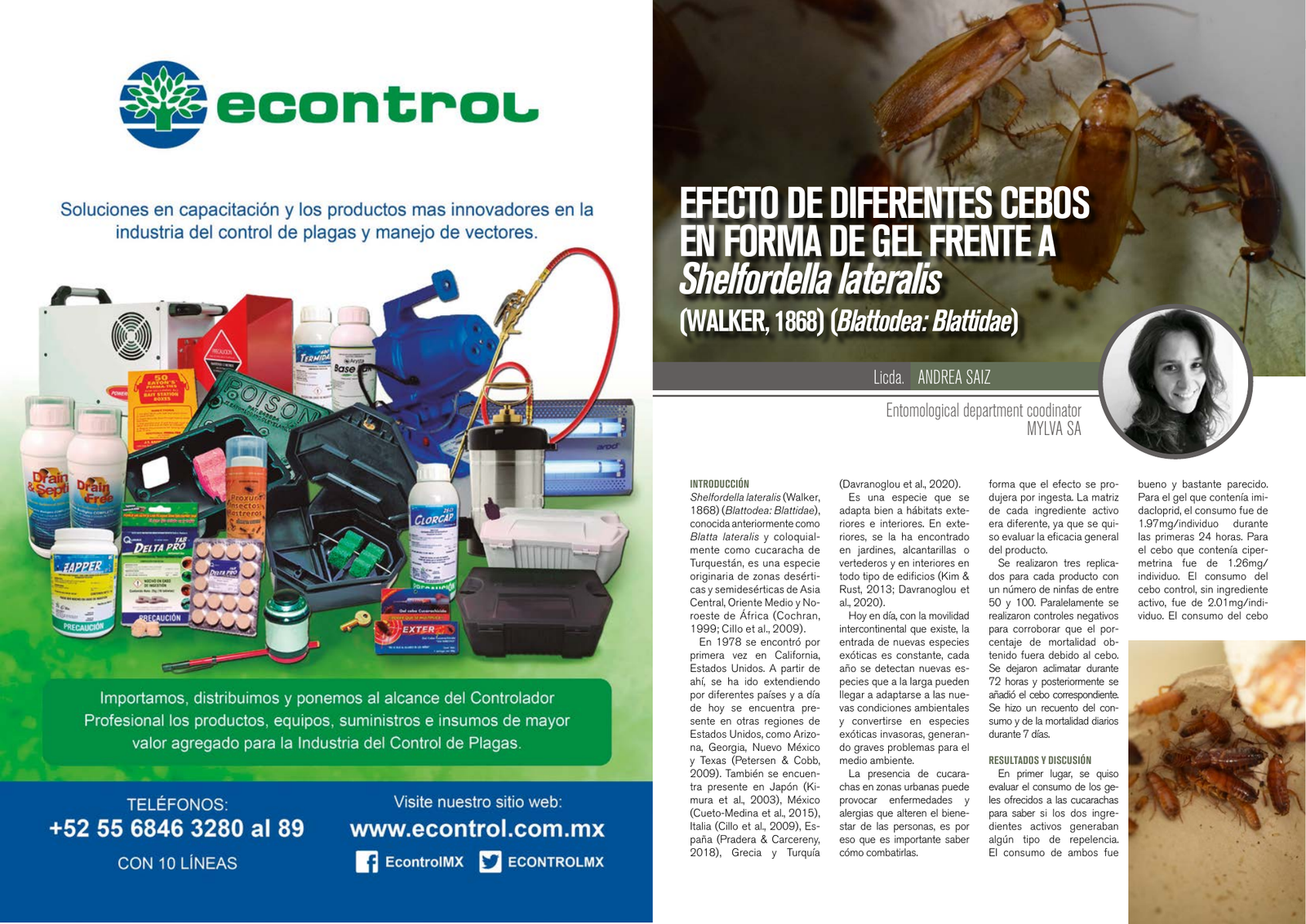
Shelfordella lateralis (Walker, 1868) (Blattodea: Blattidae), previously known as Blatta lateralis and colloquially as the Turkestan cockroach, is a species native to desert and semi-desert areas of Central Asia, the Middle East and Northwest Africa (Cochran, 1999; Cillo et al., 2009). In 1978 it was found for the first time in California, United States. From there, it has spread to different countries and today it is present in other regions of the United States, such as Arizona, Georgia, New Mexico and Texas (Petersen & Cobb, 2009). It is also present in Japan (Kimura et al., 2003), Mexico (Cueto-Medina et al., 2015), Italy (Cillo et al., 2009), Spain (Pradera & Carcereny, 2018), Greece and Turkey (Davranoglou et al., 2020). It is a species that adapts well to outdoor and indoor habitats. Outdoors, it has been found in gardens, sewers or landfills and indoors in all types of buildings (Kim & Rust, 2013; Davranoglou et al., 2020). Nowadays, with the intercontinental mobility that exists, the entry of new exotic species is constant, each year new species are detected that in the long run can adapt to new environmental conditions and become invasive exotic species, generating serious problems for the environment. The presence of cockroaches in urban areas can cause diseases and allergies that alter people's well-being, which is why it is important to know how to combat them. so that the effect was produced by ingestion. The matrix of each active ingredient was different, since we wanted to evaluate the general effectiveness of the product. Three replicates were carried out for each product with a number of nymphs between 50 and 100. At the same time, negative controls were carried out to corroborate that the percentage of mortality obtained was due to the bait. They were allowed to acclimatize for 72 hours and then the corresponding bait was added. Daily consumption and mortality were recorded for 7 days. good and quite similar. For the gel containing imidacloprid, consumption was 1.97 mg/individual during the first 24 hours. For the bait containing cypermethrin it was 1.26 mg/individual. The consumption of the control bait, without active ingredient, was 2.01 mg/individual. The consumption of the bait RESULTS AND DISCUSSION First of all, we wanted to evaluate the consumption of the gels offered to the cockroaches to find out if the two active ingredients generated some type of repellency. The consumption of both was THE MOST COMPLETE RANGE FOR INSECT CONTROL Graph 1. Average mortality with the different gel-shaped baits on the market. Source: Mylva S. A. and UCIPM with cypermethrin was slightly lower than the rest but without significant differences between them, so we can deduce that in no case did the cockroaches perceive the active ingredient and feed on them the same as they did on the one that did not contain any insecticide. Regarding mortalities, the bait containing cypermethrin generated an average mortality of 95% at 7 days, while imidacloprid generated 86% mortality also at 7 days (Graph 1). Both results are satisfactory but two of the three replicates of the gel with cypermethrin achieved 100% mortality, one of them in 24 hours, so it was considered that the product containing cypermethrin was more suitable for this species than the one containing imidacloprid. In 2019, the UC IPM (University of California Agriculture & Natural Resources) presented a study carried out with various gel-shaped baits on the market. The study, carried out in the laboratory, verified the effectiveness of indoxacarb, fipronil, thiamethoxam and abamectin as active ingredients. In the study they observed that in nymphs a mortality of 90% was achieved with indoxacarb and fipronil, 50% with thiamethoxam and 10% with abamectin, all after 7 days (Graph 1). It must be taken into account that all the tests have been carried out with final products on the market, so the matrix of each of them is different and, therefore, not only can the effect of the active ingredient be analyzed, but conclusions must be drawn about the bait in gel form in general against Shelfordella lateralis. From there, we can divide the tested gels into three groups according to their effectiveness. A first group where the efficacies have been very good, greater than 85%, where we find imidacloprid, cypermethrin, indoxacarb and fipronil. A second group with average efficacy, 50% at 7 days, with thiamethoxam, and finally, a third group, with low efficacy for abamectin. As a general conclusion, we can highlight the wide variety of gels that currently exist on the market that are useful for treating problems with this species. On the other hand, remember that good pest management involves many other preventive or structural measures apart from the application of baits in gel form in order to solve the problem effectively. Only with good integrated pest control can an optimal result be achieved. BIBLIOGRAPHY COCHRAN, D. 1999. Cockroaches. Their Biology, Distribution and Control. World Health Organization, WHOPES, Geneva. 83p. PETERSEN. W. & COBB. K. 2009. First record of the Turkestan cockroach, Blatta lateralis (Walker), in Georgia (USA). Journal of Entomology KIMURA, H., NAGANO, H., AMADA, T. & ARIYOSHI, R. 2003. On the Turkestan cockroach Blatta (Shelfordella) lateralis (Walker), found in Kobe, Japan. Urban Pest Management, 25 (2): 97-100. CUETO-MEDINA, S. M. , CASTILLO-MARTÍNEZ, A. , HERNÁNDEZ-RODRÍGUEZ, S. , MÉNDEZ LÓPEZ, R. , SÁNCHEZ-RAMOS, F. J. & ORTEGA-MORALES, A. I. 2015. Photographic atlas of the cockroaches of the Coahuila semi-desert, Mexico, Entomologia Mexicana, 2: 767-775. CILLO, F. , FOIS, F. , BAZZATO, E. & PIRAS, P. 2009. 484 – Blatta lateralis Walker, 1868 (Blattaria: Blattidae): Prima segnalazione per la Sardegna di specie di origine medio – orientale currently introduced and diffuse in various regions of the globe. Bollettino della Società entomológica Italiana, 141 (2): 113. PRADERA, C. & CARCERENY, A. 2018. Primera citation de dues espècies exòtiques de paneroles (Insecta: Blattodea) per a la peninsula Ibérica: Pycnoscelus surinamensis (Linneaus, 1758) i Blatta lateralis (Walker, 1868). Butlletí of the Catalan Institute of Natural History, 82: 23-24. DAVRANOGLU, L. R. , HADJICONSTANTIS, M. , & MANN, D. J. 2020. First record of the Turkestan cockroach (Shelfordella lateralis) from Cyprus and Turkey (Dictyoptera: Blattidae). Israel Journal of Entomology, 50 (1): 1-8. KIM, T. & RUST, M. K. 2013. Life history and biology of the invasive Turkestan cockroach (Dictyoptera: Blattidae). Journal of Economic Entomology, 106(6): 2428-2432.