
Cannons at the price of guns
When almost 20 years ago I went from technician to technical manager, the manager of the company where I worked entrusted me with the job of purchasing manager.
Technical summary
- Focus
- When almost 20 years ago I went from technician to technical manager, the manager of the company where I worked entrusted me with the job of purchasing manager.
- Approach
- It brings together technical criteria linked to Edición 13, cebos and cucarachas.
- Use
- Useful for professionals who need context, diagnosis and operational decisions in integrated management.
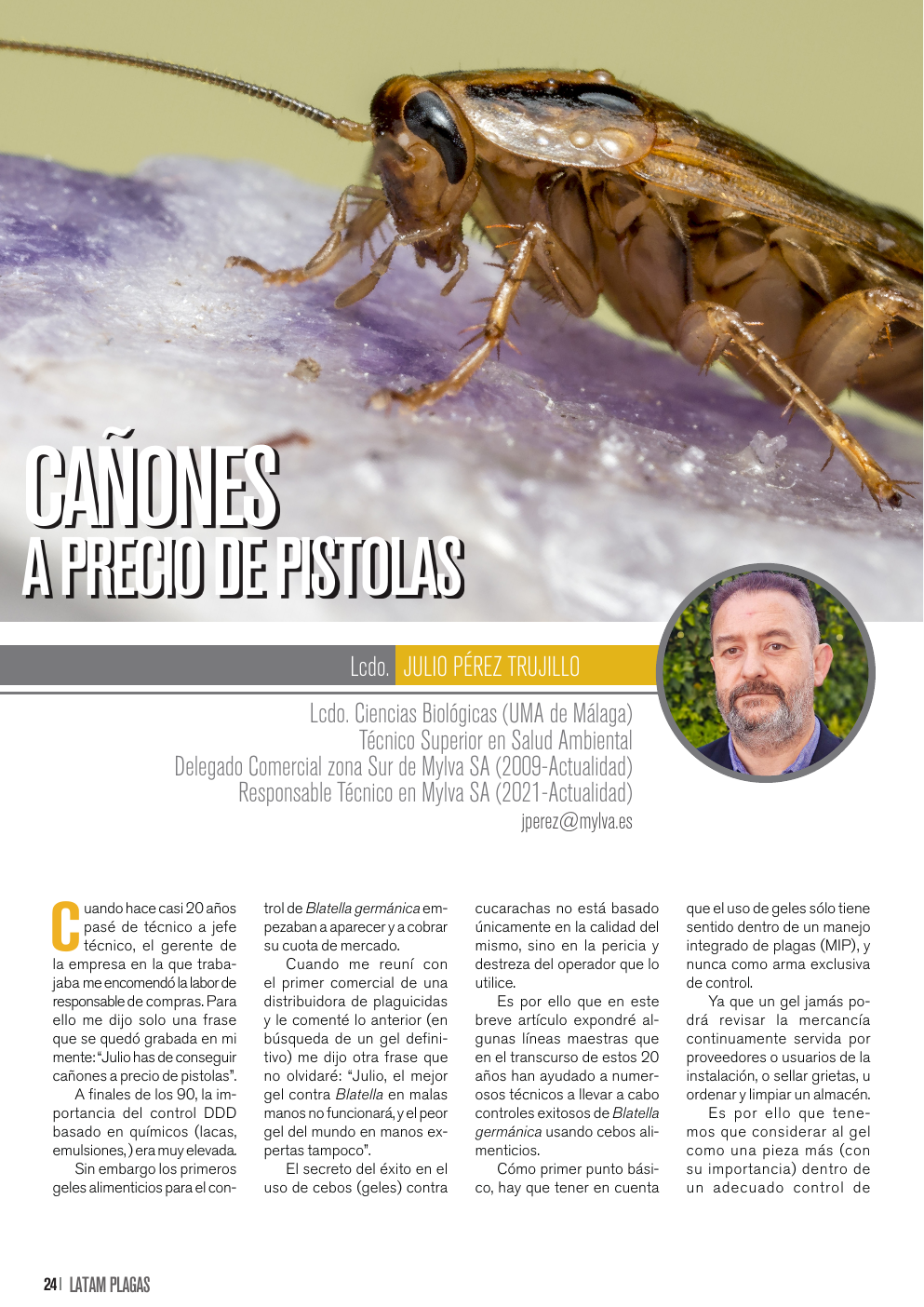
When almost 20 years ago I went from technician to technical manager, the manager of the company where I worked entrusted me with the job of purchasing manager. To do this, he told me only one phrase that remained engraved in my mind: “Julio, you have to get cannons at the price of guns.” At the end of the 90s, the importance of DDD control based on chemicals (lacquers, emulsions, etc.) was very high. However, the first food gels for the control of Blatella germánica were beginning to appear and gain their market share. When I met with the first salesperson of a pesticide distributor and I told him the above (in search of a definitive gel) he told me another phrase that I will not forget: “Julio, the best gel against Blatella in bad hands will not work, and neither will the worst gel in the world in expert hands.” The secret to success in using baits (gels) against cockroaches is not based solely on its quality, but on the expertise and skill of the operator who uses it. That is why in this brief article I will present some guidelines that over the course of these 20 years have helped numerous technicians to carry out successful controls of Blatella germánica using food baits. As a first basic point, we must keep in mind that the use of gels only makes sense within integrated pest management (IPM), and never as an exclusive control weapon. Since a gel will never be able to check the merchandise continuously served by suppliers or users of the facility, or seal cracks, or organize and clean a warehouse. That is why we have to consider the gel as one more piece (with its importance) within an adequate control of cockroaches in the facilities to be controlled. Once this is assumed, we can proceed to establish a series of guidelines that will optimize its use and results. If we assume that we have carried out a thorough inspection of the premises and confirmed the presence of Blatella germánica, as well as structural or behavioral problems of the users, we can proceed with the following steps in the use of the gels: A- Monitoring assistance: An effective use of baits requires good prior monitoring that allows us to know the level of infestation, seasonal population movements and the population pyramid (which phases predominate). And of course define the critical points where treatment is really necessary. B- Rational placement of the priming points: a. They must be points in areas of frequent passage and close to refuge points, since cockroaches tend to optimize their movements just like humans. b. Do not place baits in points with excessive dirt or with access to contact with it, as it could become contaminated, affecting the palatability, attraction and conservation of the bait. c. Caution with excessively hot spots. Although cockroaches prefer hot engines and areas for their nesting, if this is excessive it will not favor this process and will also accelerate the drying of gels without adequate hygroscopic capabilities. d. Bringing the gel closer to areas such as cracks, crevices and narrow spots (gaps between furniture) encourages cockroaches to access it, since by nature they seek this type of shelter. C- Do not exceed the number of control points. An intelligent placement adapted to what was detected in the monitoring process will be much more effective than a placement at the discretion of points, since it avoids product waste, risks, and above all, it does not favor population dispersion to areas that do not interest us. D- Droplet size and distribution that favor access. The drops must not be excessively large or they will end up producing repellency and/or spoiling more quickly. A size of 2-3 mm in diameter is usually ideal. And a separation between points of at least 10 cm is also recommended. E- Security of the bait. In the early days of bait use, the active ingredient (IAT) predominated over any type of safety concept. But currently it is important that our bait is as specific as possible for the problem species and safe for the users of the facility. Active components that are activated by ingestion of the target species (such as indoxacarb) or that cause the rejection of non-target species (such as bitrex®) are requirements that are increasingly demanded by clients. G- Do not mix. It is important that when we change the control gel (either in IAT or in food matrix) we remove the remains of the previous unconsumed gel. Since on the one hand they will alter the results of the new gel (when they dry they cause repellency and displacement of the populations), and on the other hand they can lead us to error in the interpretation of the results obtained. Of course, if a control support is used due to the use of a biocide that emits vapors, the points must be replaced once the appropriate waiting time has passed. F- Adapt the type of bait to the problem. One of the advantages of current baits compared to the beginnings in the late 90s is the multitude of gels with different IAT, food matrices and effects on the target population. This allows us not only to select the most appropriate bait for the local situation, but also provides us with the much-needed rotation regime to avoid population adaptations. H- Use of combinable pesticides. In addition to the use of monitors as support, it is important to select other biocides that help us with effective control, such as diatoms (they allow us to protect larger areas of passage, and act on individual inMIPs that approach attracted by the gel), or gel-type lacquers that allow us to confine a population in the area in which we want to promote gel consumption and thus prevent them from accessing other food sources. I- Protection of points. It is widely known that many users of treated facilities do not have patience and try to accelerate the results by applying their own products (and contaminating our points), or due to lack of knowledge they may eliminate them in cleaning processes. That is why in areas where this may occur or we suspect it, we proceed to protect our points with bait stations that allow cockroaches access to the bait, but not to contaminating agents. Once we are clear about how to use a food gel against cockroaches, we are going to explain the types of gels that we can find and why to use them: 1-High Palativity Gels: In those cases where the infestation is high per number of specimens, and these are from all stages of development, we must resort to a highly palatable gel with a mortality effect that is not excessively slow. One possibility would be food gels with a high amount of water, which makes them very attractive. 2- Mixed Activity Gels: Currently we have formulations with several active ingredients in their formula. This allows combining the effects of an adulticidal IAT with those of an ovicidal IAT that affects the development of the oothecae and therefore weakens the capacity for replacement of specimens in future generations. An example of this type of gel is the Magnum®/Ultimatum® IGR gel against cockroaches, which has Imidacloprid (adulticide) and S-Methoprene (ovicide) in its formula. 3- High persistence gels (maintenance): When we treat a facility, there comes a time when we must have food gels that are capable of remaining fresh and palatable for long periods of time that allow the gel to effectively deal with possible reinfestations. High hygroscopic effectiveness (ability to capture ambient humidity). An example of gels with high persistence and effectiveness maintained over time is the Magnum®/Ultimatum® gel against cockroaches, a gel with the ability to stay fresh for periods of 6-8 weeks even in high temperature areas. 4- Gels against Aversion: It is increasingly common to find populations of blatella with the mutation that causes them to have an aversion to glucose in our facilities. Therefore, having access to formulas that not only vary the IAT, but also allow us to use a food matrix free of sugars (to avoid the appearance of glucose due to their degradation), is essential to be able to control them. An example of this type of gel would be Magnum®/ Ultimatum® Optimum gel, specially designed for blatella with aversion, but which can also be consumed by those without it. A good applicator will be able to use the types of gels described above, as the local situation varies, responding and adapting to the control in the most effective way that it demands. Implementing active rotation programs will prevent the appearance of population adaptations that reduce the effectiveness of control, and therefore will not develop a selection of one group over others with different abilities or qualities. What I hope is clear to us after this explanation is that cannons will never be more effective (no matter how cheap they are) than good precision pistols handled wisely by skilled shooters. The continuous training of our technicians, as well as their knowledge of new technology and components, will facilitate their response to different problems and situations in which biocides alone will not work if they are not used properly.