Audits and transparent processes in pest control
THE NEW STANDARD IN PEST CONTROL In a context where traceability, food safety and audits have become the daily bread for production, logistics and retail companies, the pest control service can no longer be improvised.
Technical summary
- Focus
- THE NEW STANDARD IN PEST CONTROL In a context where traceability, food safety and audits have become the daily bread for production, logistics and retail companies, the pest control service can no longer be improvised.
- Approach
- It brings together technical criteria linked to Edición 17, auditorías and digitalización.
- Use
- Useful for professionals who need context, diagnosis and operational decisions in edición 17.
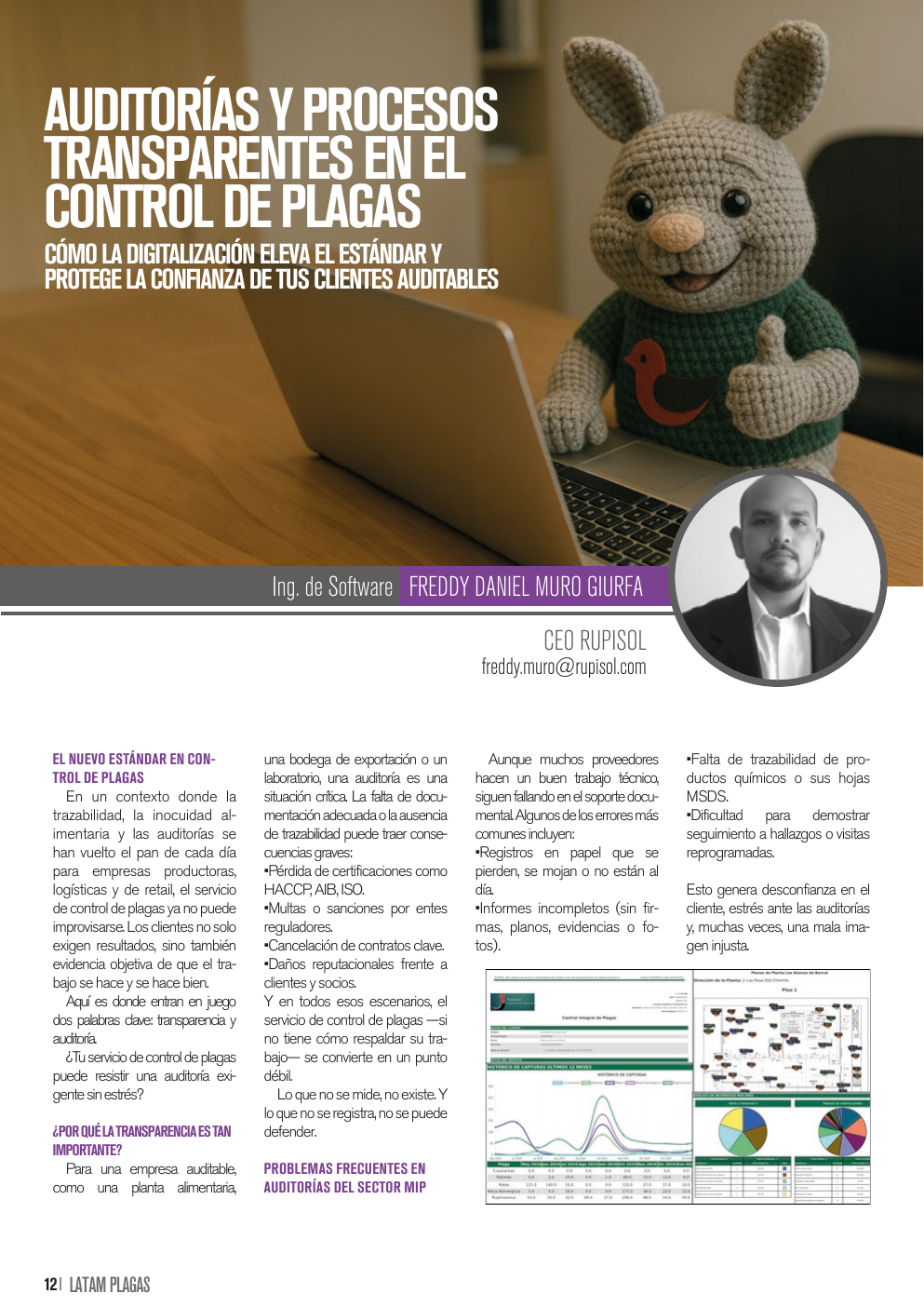
THE NEW STANDARD IN PEST CONTROL In a context where traceability, food safety and audits have become the daily bread for production, logistics and retail companies, the pest control service can no longer be improvised. Clients not only demand results, but also objective evidence that the job is done and done well. This is where two key words come into play: transparency and audit. Can your pest control service withstand a demanding audit without stress? WHY IS TRANSPARENCY SO IMPORTANT? For an auditable company, such as a food plant,
an export warehouse or a laboratory, an audit is a critical situation. The lack of adequate documentation or the absence of traceability can have serious consequences:
- Loss of certifications such as HACCP, AIB, ISO.
- Fines or sanctions by regulatory entities.
- Cancellation of key contracts.
- Reputational damage to clients and partners.
And in all these scenarios, the pest control service—if it does not have a way to support its work—becomes a weak point. What is not measured does not exist. And what is not recorded cannot be defended. FREQUENT PROBLEMS IN AUDITS OF THE IPM SECTOR
Although many providers do a good technical job, they continue to fail in documentary support. Some of the most common errors include:
- Paper records that get lost, wet, or not up to date.
- Incomplete reports (without signatures, plans, evidence or photos).
- Lack of traceability of chemicals or their MSDS sheets.
- Difficulty demonstrating follow-up on findings or rescheduled visits.
This generates distrust in the client, stress when faced with audits and, many times, an unfair bad image.
GOOD PRACTICES FOR AUDITABLE AND EFFICIENT PROCESSES Leading companies in the sector are adopting new practices supported by technology to ensure the quality, traceability and transparency of the service. Some of them are:
- Use of specialized software to record each visit, finding and corrective action.
- Digital reports with geolocation, photos, plans and electronic signatures.
- Centralized documentary control of chemical products, technical sheets and permits.
- Automatic protocols for monitoring incidents or rescheduled treatments.
- Remote, real-time access to the client's complete history, ideal for unscheduled audits. This not only reduces errors: it builds trust. TECHNOLOGY AS A STRATEGIC ALLY With solutions like Rupipest, today it is possible:
- Automate reports and minimize human errors.
- Have alerts for overdue visits or unattended findings.
- Integrate compliance KPIs with control dashboards.
- Access information at any time, from
Strict needs to feel protected by your pest control provider. If you can guarantee clear reports, solid evidence and optimal response times, you are helping them solve a real problem. And as we well know, it is more profitable to retain an existing customer than to get a new one. Investing in technology is not an expense: it is a smart business strategy. WHAT DO THE RULES SAY? While each standard has its own requirements, many standards align with the recommendations of ISO 19011:2018, which regulates how to audit management programs. The pillars include:
- Audit planning and definition of objectives.
- Selection of the audit team.
- Collection of objective evidence.
- Documentation of findings and follow-up. A well-digitized pest service makes it easy to accomplish all this without friction. CONTINUOUS IMPROVEMENT: THE DEMING CYCLE IN ACTION Every auditable process must conform to the continuous improvement cycle (Plan–Do–Check–Act). Rupipest makes it easy with:
- Defined action protocols (Plan).
- Field execution with evidence (Do).
pest control in more than 18 Latin American countries. Today we register:
- +40,100 installations
- +215,000 active checkpoints
- Automatic reports for supervision (Check).
- Alerts and operational settings (Act). Thus, each inspection is not only a control, it is an opportunity for constant optimization.
- +3.2 million digitized inspections. We believe in an industry that is more technical, more reliable and better prepared for the challenges to come.
THE REAL IMPACT OF DIGITALIZING PROCESSES Digitizing your pest control company is not just about “looking modern.” It is a profound transformation with real impacts: TRANSFORMING THE SECTOR IN LATIN AMERICA At Rupipest, we have accompanied the digitalization of any place.
- Streamline operational and commercial decision making. Digitizing doesn't just mean modernizing, it means professionalizing your company. A client that passes audits
IS YOUR COMPANY READY? If you still work with paper or craft reports, it's time to ask yourself:
- Are you ready for an unscheduled audit?
- Do your clients feel protected by your service?
- Can you demonstrate your value with evidence, not just words? If the answers are not a resounding yes, technology can help you.
"Someone comes along with an innovative service and moves your world. You say: How is this so easy? This shouldn't be so easy!" – Lawrenz Ayala, Mexico. 2023