
Storage of merchandise should be a constant concern
According to the FAO, 1/3 of the world's population lacks food. 20% of global production of stored products is lost..
Technical summary
- Focus
- According to the FAO, 1/3 of the world's population lacks food.
- Approach
- The article structures the analysis around industrial toilet, Waste disposal and Pre-stocking treatment.
- Use
- Useful for professionals who need context, diagnosis and operational decisions in food safety and industry.
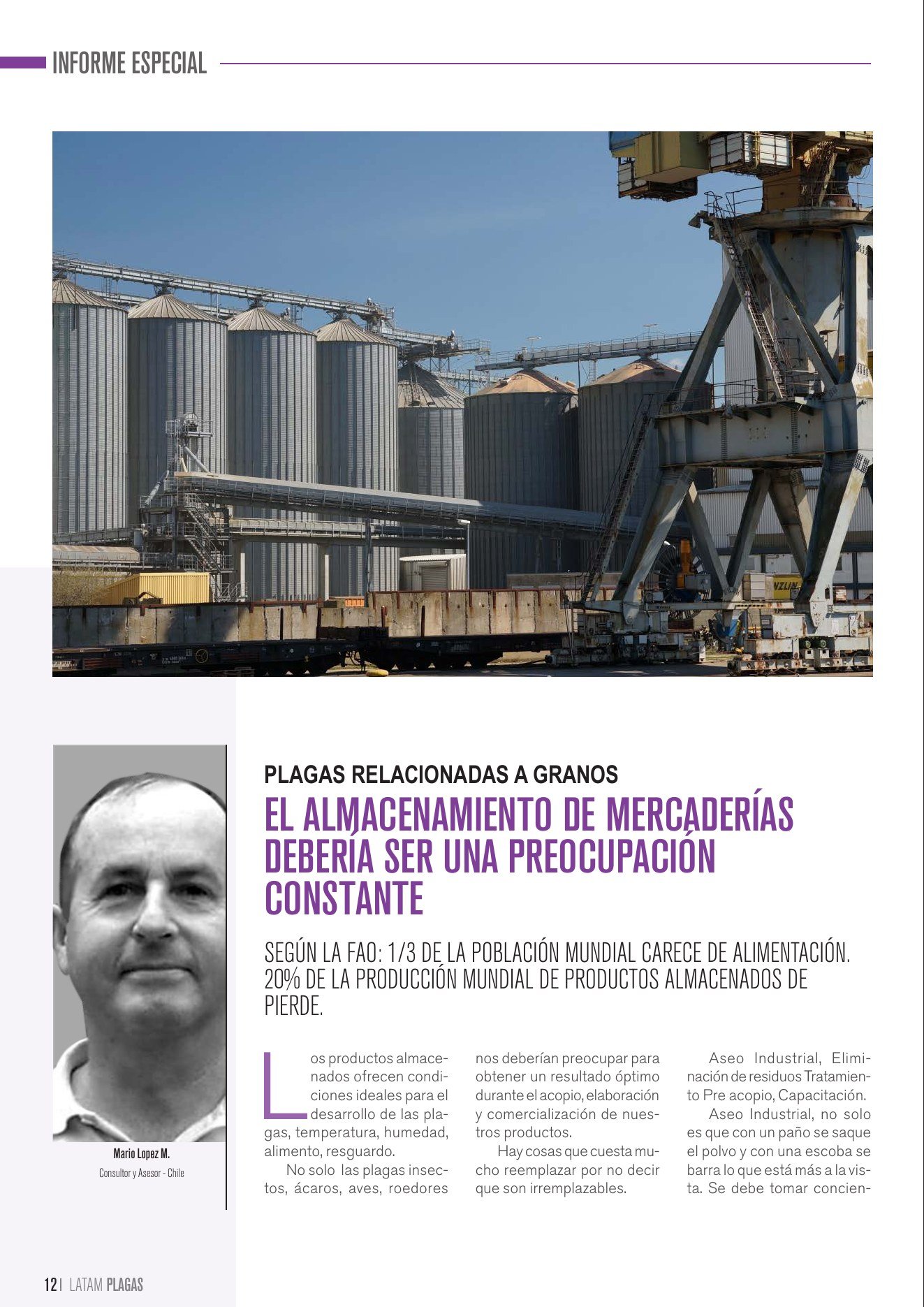
According to the FAO, 1/3 of the world's population lacks food. 20% of global production of stored products is lost.
Stored products offer ideal conditions for the development of pests: temperature, humidity, food, shelter.
Not only insect pests, mites, birds, rodents should concern us to obtain an optimal result during the collection, production and marketing of our products. There are things that cost a lot to replace, not to mention irreplaceable.
Industrial Cleaning, Waste Disposal, Pre-stocking Treatment, Training.
industrial toilet
Industrial Cleaning is not only about removing dust with a cloth and sweeping up what is most visible with a broom. Awareness must be raised about this issue, it is the one that requires the most attention and is the point where the best results can be obtained to minimize the presence of insects, minimize the possible cross contamination that exists throughout the production chain.
Cleaning facilities from an aesthetic point of view is different from cleaning from a sanitary point of view. Determine the dimensions, characteristics and sanitary condition of the facilities.
Before grain arrives at your silos or warehouses, these structures must be prepared so that the merchandise does not become contaminated and deteriorate. Do I have adequate conditions for storing the goods?
Order and cleanliness, maintenance of the peripheral area free of garbage, weeds, waste and interior, receipts, floors, ceilings, walls, storage areas. Cleaning of equipment used during the storage and manufacturing process. How to do it: removing crusts, dust, residues from the grains that remain from one collection to another.
Insecticide applications on these residues have no effect; The insecticide does not reach under the scab, the dust and therefore its effectiveness is lost.
Waste disposal
If we carry out good industrial cleaning, it means that we collected a quantity of waste, garbage, dust, grains stuck to the walls, compacted grain, etc. What do we do with this waste? The plant must have a defined protocol to quickly eliminate it from within its perimeter. Arrange them in airtight containers, fumigate them, take them to an area for final disposal so that cross contamination does not occur.
You should know that when you invest in good industrial cleaning, you are saving in the short term and positioning your products with better quality and safety.
As a risk preventionist, it will be necessary to consider how to enter an empty silo and begin this cleaning, so that an accident does not happen. On the contrary, hire companies specialized in this topic.
Pre-stocking treatment
A treatment via a residual insecticide must be scheduled before the goods enter the plant. Where to do it: empty silos, warehouses, transportation system, elevators, grain unloading, truck entry (rodeluge) with the corresponding methodologies: U.L.V., thermofogging, spraying, via dust, smoke, gas according to the airtightness of the structure, etc.
What is achieved with these treatments? Reduce the presence of insects that enter the plant, reduce cross contamination in elevators, discharge tubes, silos, etc. Chemical control cannot compensate for poor sanitation and cleanliness. Use cultural, physical, chemical and biological control tools.
Training
None of the above is achieved if the people who will do these tasks are not prepared. Any person cannot enter an empty silo alone and begin this cleaning. Are personnel prepared to apply insecticides? What type of wetting to do, what dilution of the product, what protective elements should you use, at what time to apply, what methodology to use?
You must have prepared personnel, trained in these tasks. Companies and their management must assume that this is not an expense but an investment. Have you quantified your losses by the damage caused by pests? Have they quantified how much image damage costs them when merchandise has to be removed from the end customer? Have they quantified stopping participation in a certain market because they cannot meet food safety requirements?
Programming permanent activities, efficient in their work, proactive, analyzing the effectiveness of what has been done, monitoring, are the responsibilities of the administration so that pest control is excellent. We must dedicate more time to prevention and not so much to control.
Preventive strategies are more effective in reducing pest pressure. When the grain is already stored in a silo or warehouse, pest control strategies are reduced.
There are other factors that must be taken into account when collecting merchandise: aeration, grain conditioning, drying, temperature, monitoring.
Permanent rule for storage conservation: hygiene, grain transportation, aeration and monitoring.